Friday, March 11, 2016

The Importance of Regular Reflection

In an article recently posted on the Harvard Business Review website, Laura J. Adler articulates why it is important for leaders in a organization to journal regularly.  My father clearly had the same information because my sister and I were required to keep a journal starting in fifth grade.  My journals have always been a place of comfort and growth even though I resisted my father in the beginning.  Over the years, they have definitely changed in size, shape and content (high school drama!) but they have remained a consistent tool for my personal and professional growth.  Adler discusses several key components to journaling that will make it a more worthwhile process.

  1. Buy a journal - There is something about a composition book that I just love.   I have received many gifts of pretty journals but I always feel like there is too much pressure to write something profound.  But over the years, I have used binders with plain notebook paper too.
  2. Commit to reflecting - When I am most productive, I am also journaling all the time.  It helps me focus my thoughts and prepare for the next day.  I usually write my journal at the end of the day right before I go to bed.  I have fallen asleep writing my journal many times and I think that I probably should avoid writing my journal in bed.  My goal has been to fill up at least two pages of writing every night, an idea I got from reading The Artists Way many years ago.  Sometimes I succeed - other times I don't.  But the goal is set.
  3. Find a quiet place - I often struggle with this because of my two young children who pop up out of bed from time to time.  Still - my room is quiet and comfortable and meets this criteria.
  4. Choose the right time - As an instructional coach, there is no such thing as not being interrupted when I'm at school.  I want to be available to my teachers for anything that might come up.  This means I have to journal at home and with my sons at home - this can also be a challenge to find.  
  5. Write whatever comes to mind - Going back to the idea of always writing something profound - sometimes empty pages are incredibly daunting to me.  Part of writing for most people, even accomplished writers I have heard, is just doing it.  I will (and do) make excuses to not write but just getting the messy ideas down allows for the better ideas to come to the surface.
  6. Don't share your journal with anyone - I have to say I disagree with this one.  I am not saying that we should always share ideas all the time - certainly there are ideas that I want to keep to myself.  But I do think that selectively sharing our ideas, even the messy ones, with people in our thought community or personal learning network can help us grow.  But then again I am a huge Vygotsky fan and agree with him that knowledge construction happens through dialogic communication.  
I also like to track patterns in my journal.  I like to end each entry with:
  • Things that I'm proud of:
  • Things I need to work on:
  • Book(s) I am reading:
This regular pattern helps me close out my final thoughts for the night. 

I would love to hear if you keep an off-line journal.  If you do - how many of Adler's ideas are you able to apply?  Is there any ideas that you struggle with?

Tuesday, March 1, 2016

16 posts?

It's been 10 months since my last post.  This year has gotten away from me and I have failed to keep up with my goal of posting once a week.

This morning I was able to attend the DuPage County Instructional Coaching Network Meeting in District 58 and the closing activity was a "Start Continue Stop" reflection which we then had to share with others.  So here is mine to share with the world:

Start:  Blogging again - once a week!
Continue:  To reach out and network with amazing teacher leaders
Stop:  Trying to work with people who don't want to work with me

Let's make this happen!

Tuesday, April 14, 2015

What I Learned This Week: Digital Citizenship

Ok. I knew about Digital Citizenship before but what I really learned this week was how important it was to model good digital citizenship so students know what to expect from each other.


The ISTE Standards for Students describes one aspect of digital citizenship as the ability to “exhibit a positive attitude toward using technology that supports collaboration, learning, and productivity.”   In addition to ISTE, the Common Core would like our students to also engage with technology to collaborate with their students.


It would be great to assume that students would use an online forum to only engage in content and not write silly messages to each other but we teach in the “real” online world.  In this world, we know that a 15 year old will behave like a 15 year old, as an avatar or in person.


I made the mistake of asking a teacher to try an activity without talking to the students about digital citizenship first and the result is probably what you can imagine:  the freshmen students behaved like freshmen.  The teacher came to my office frustrated with the assignment, his students, and me.  


Lesson learned:  Develop a short introduction to digital citizenship before expecting students to work in a shared online document.


I used the FREE online curriculum provided by Common Sense Media to adapt two of their lessons (Chart It! and Forms and Norms) to do a short 10 minute introduction for students.  This reduced the amount of silliness that would normally occur in this situation.  The model lesson gave students the permission to determine what collaboration would look like in their classroom.  When they were given the actual task - they were able to attend to it immediately.  Taking these 10 minutes out improved the student work product with no frustration on the part of the teacher.  

Would you like me to model this for your classroom?    Let me know!

Check out our curated collection Digital Citizenship materials http://bit.ly/REALDigitalCitizenship.  

Monday, April 6, 2015

Rolling with my Chromies

What does your Internet browser say about you?  More than you think, according Cornerstone OnDemand, an organization that helps many corporations recruit and train employees:
Here’s what they found:
Source: The Atlantic

The company is quick to point out the correlation does not mean that just because a person uses Internet Explorer they will be a bad employee.  

The question I still have is:  if our students are 1:1 CB users (and thereby forced to use Chrome), then does this data apply (ISTE Technology Standard 6)? To take it further - does pushing documents through Google Classroom or Hapara teach them the digital skills they need to be more productive?

Tuesday, March 10, 2015

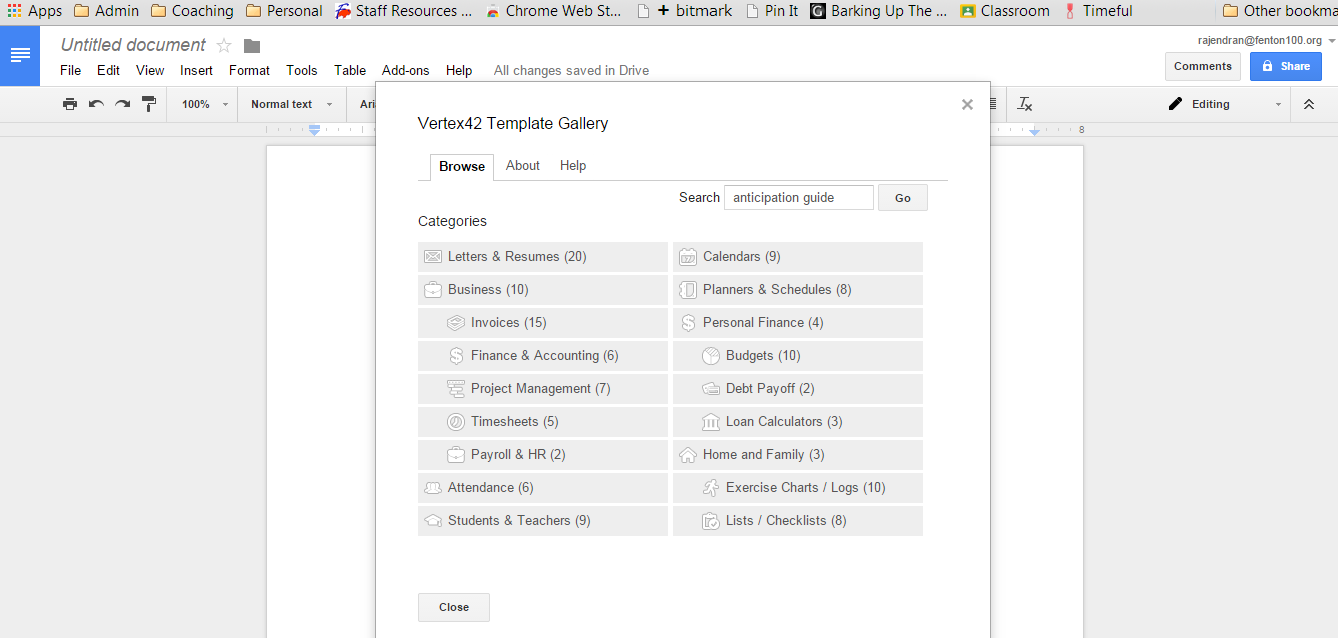
Don’t Reinvent the Wheel: Use Google Templates

I stumbled across a gold-mine two-weeks ago and but I was scooped by the Educational Technology and Mobile Learning blog before I could bring it you.  


In case you missed that post . . .


friends, I bring you - Google Templates Gallery.  


This gallery includes pre-made Forms, Slides, Docs for all content areas.  Whether you need a pre-made Spreadsheet to so students can calculate their personal budgets, a Doc to create their own personal exercise plan, or a "God"book page - templates has a solution for you.


I created my own and added them to our Fenton gallery (including a Forms Anticipation Guide, Learning Profiles, and Gallery Walk).    If you are not a FHS-domain user, please send me an email and I can share these tools with you.


Install the extension from THIS PAGE and create Google-fied classroom materials in a snap.

Wednesday, December 10, 2014

Word Clouds

Word Clouds are a beautiful way to engage students with vocabulary or themes within content.  Many people are already familiar with Wordle but I was frustrated that the site didn't allow me to manipulate the image into a relevant shape.  

Enter Tagul and Tagxedo.  Tagul even talks to Google so that is nice if you're a Chromebook user.

The I created this Word Cloud in a few minutes using our FHS logo on the website Tagxedo.


Here is one that uses President Obama's inauguration speech to create his campaign image.  

To see some other examples of Word Clouds - check out their gallery.

This gave me the idea of how to use word clouds in the classroom and the corresponding Common Core Standards.


CCSS.ELA-LITERACY.CCRA.R.2 Determine central ideas or themes of a text and analyze their development; summarize the key supporting details and ideas.
  1. After reading an informational text, create a GIST summary of the text (this site explains GIST if you have never used it before).  Use the 20-word GIST to create the word cloud. 
  2. Review direct and indirect characterization with students.  Use a mnemonic like STEAL  to ask students to review the text for examples of indirect characterization.  Use their findings to create word clouds for characters in a novel or historical figure.  
CCSS.ELA-LITERACY.CCRA.R.4 Interpret words and phrases as they are used in a text, including determining technical, connotative, and figurative meanings, and analyze how specific word choices shape meaning or tone.
  1. Use the Frayer Model to identify essential characteristics OR examples of a vocabulary term to create a word cloud.  This could be used in any subject area with almost any key term.
  2. Use the theme or main idea of a story as the figure image.  This would be a .jpg or .png file of a word.  The word cloud would be made up of phrases that piece together the text's meaning/tone.  Here is one I created for To Kill a Mockingbird.  


CCSS.ELA-LITERACY.RI.9-10.7
Analyze various accounts of a subject told in different mediums (e.g., a person's life story in both print and multimedia), determining which details are emphasized in each account.
  1. Use the CIA World Factbook to highlight specific features of a specific country.  Compare the word cloud to an informational text.
  2. Compare two sides of an argument to see which side uses specific words more frequently.  
CCSS.ELA-LITERACY.CCRA.W.6
Use technology, including the Internet, to produce and publish writing and to interact and collaborate with others.
  1. Any application works!
Any other suggestions?  Add them below!!

Tuesday, November 18, 2014

If You Give Reminders, Your "Teammates" Will Play Better

One of my fellow Bison sent this video to me after we were discussing maintaining expectations for behavior in a classroom.  He is also a basketball coach which is how he came across the video.  We both agreed that while the video is very much about basketball specifically - the information can be directly applied to a classroom (or board room). At 3 minutes - it's the right time frame for busy professionals - Go ahead and watch it.  My connections to education are below:


The video says:  Give a reminder before it's needed - feedback after the event is not leading - it's"complaining about something after the fact".  We have to "recognize the situation before it happens and give a reminder then."

These quotes reminded me of the formative feedback we provide students during a lesson.  When a student asks a question in class about the concept, we know that we need to remind them of the correct way to address the topic.  The advantage of teaching a class multiple times is that you can begin to predict what will be the areas of confusion.  By giving the students reminders of what these misconceptions will be for a unit will help them avoid the mistake altogether or at least predict that the next section might be challenging for them.

Also, knowing a subject does not mean that we can always predict the background knowledge of each student.  Just because for the past few years, the students always understand A but not B does not mean that we can assume that all of our students are going to understand A.  This is when differentiated feedback becomes very important.  It is not enough to tell a student that they got the problem wrong (the student could have used the key to grade the problem themselves) but also to provide the information to take action to prevent it from happening again (Fisher & Frey, 2009).  This is most helpful in a formative lesson. 

As a classroom teacher, I would spend hours pouring over student short answers and provide detailed feedback about what they got wrong.  This is similar to the point guard that gave the reminder after the other team scored - complaining after the fact.  My students usually would glance at the grade they got on top, be satisfied or upset about their score and move on.  I would get so upset but what purpose did my feedback serve in their lives?  It wouldn't help them earn a higher grade and it did not tell them how it could be used in the future.  In other words, it wasn't relevant . . .

The video says:  Great leaders "constantly give reminders that is relevant" 

Regular reminders help students monitor their progress.  After repeated reminders given from the teacher, the student will start to hear the reminders in their own minds.  When a person is learning to drive, the instructor gives them a steady stream of reminders to make sure their safety and the safety of others is ensured.  Text-dependent citations are not a life-or-death situation but giving students the a process reminder will still yield strong results.  

How do you use reminders in your world?